For microschools & small private schools
Know your school's numbers before you sign the lease.
SchoolMath Kit is a plain-English financial model for school founders and owners. Type your numbers into the yellow cells and see your budget, month-by-month cash, break-even enrollment, and when voucher or ESA money actually arrives.
- Excel & Google Sheets
- No macros
- Built by a private school owner in Indiana
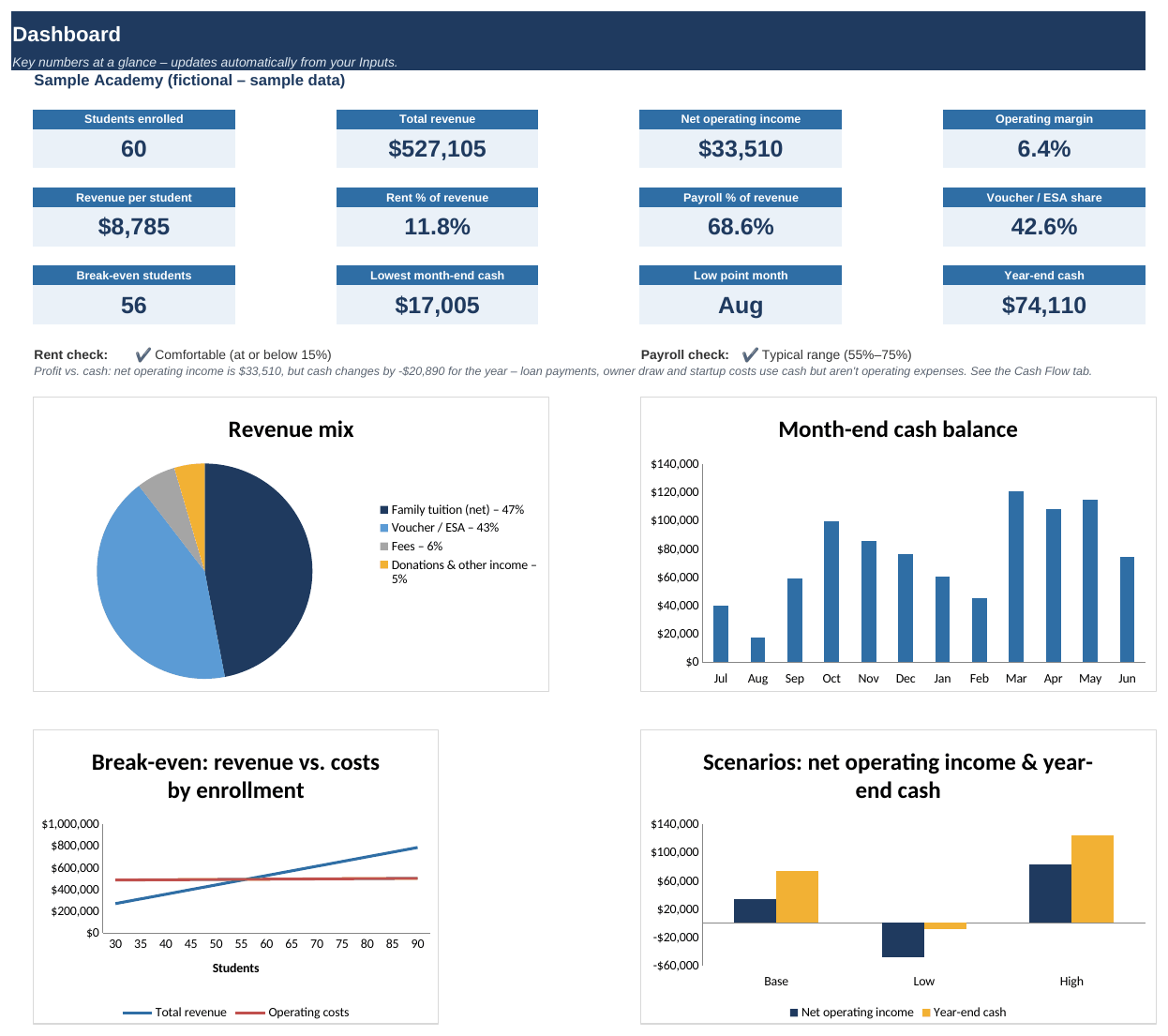
See it in action
Watch the model answer “How many students do I need?”
An 80-second look at the Break-Even tab, from the full walkthrough included in Kit Plus.
The problem
Most school money trouble is a math problem that showed up late.
You started a school to teach kids, not to build spreadsheets. But a few numbers decide whether your school makes it through year one, and they're easy to miss.
Profitable on paper, short in August
Payroll and rent are due every month. Tuition and voucher payments come in on their own schedule. You can have a good year and still miss payroll in late summer.
The lease gets signed first
Rent you agree to before you know your break-even enrollment can stay with you for the whole lease.
Tuition copied from the school down the street
Another school's price says nothing about your costs. Discounts, aid, and bad debt quietly cut into what you actually collect.
Vouchers change the timing
Voucher and ESA money helps families afford your school, but it often arrives in lump sums weeks after school starts.
What's inside
One workbook. Eight tabs. Every number connected.
You enter your numbers once, on one tab. Everything else updates on its own. These are real screenshots from the model, filled with sample data.
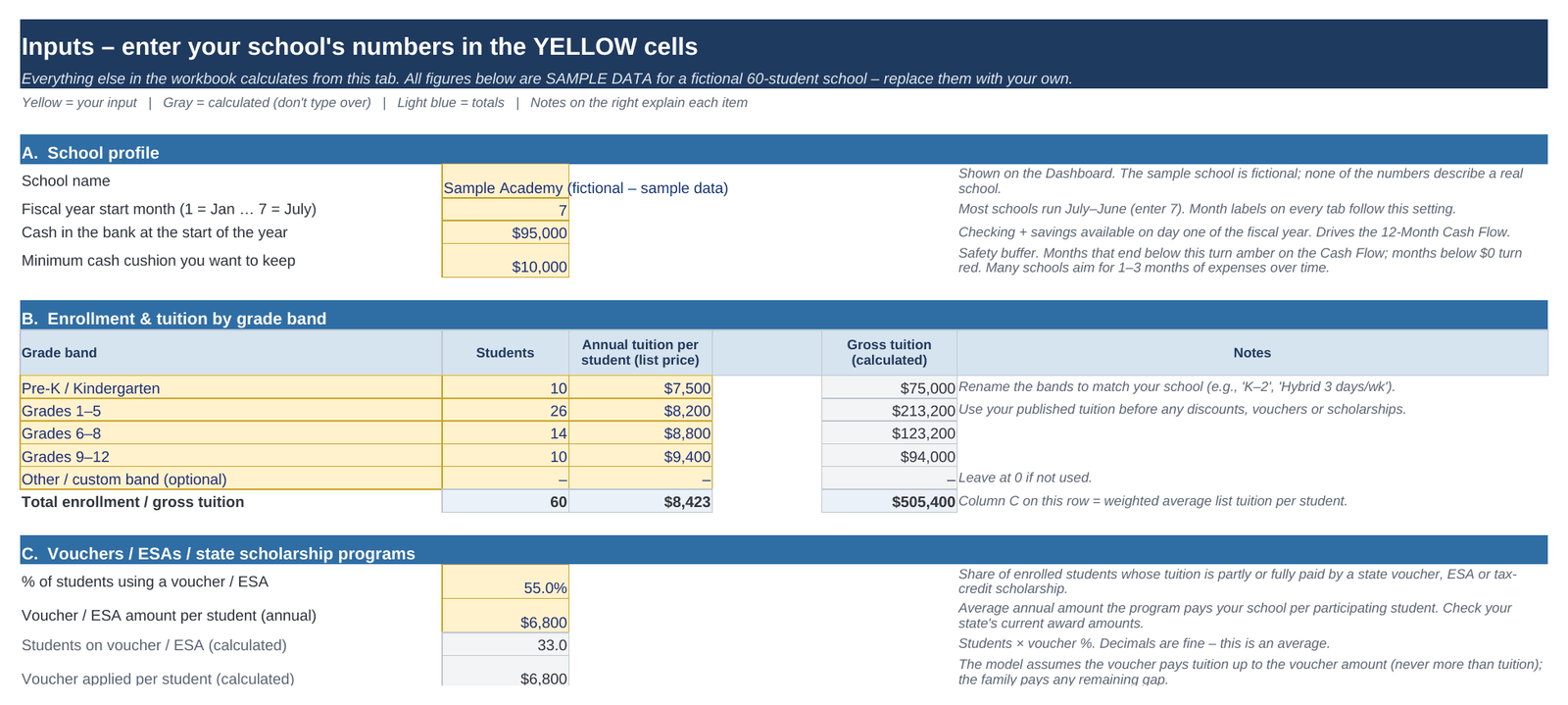
Type only in the yellow cells
Enrollment and tuition by grade band, vouchers and ESAs, discounts and aid, fees, donations, staff, rent, and startup costs. Every input has a note in plain English next to it.
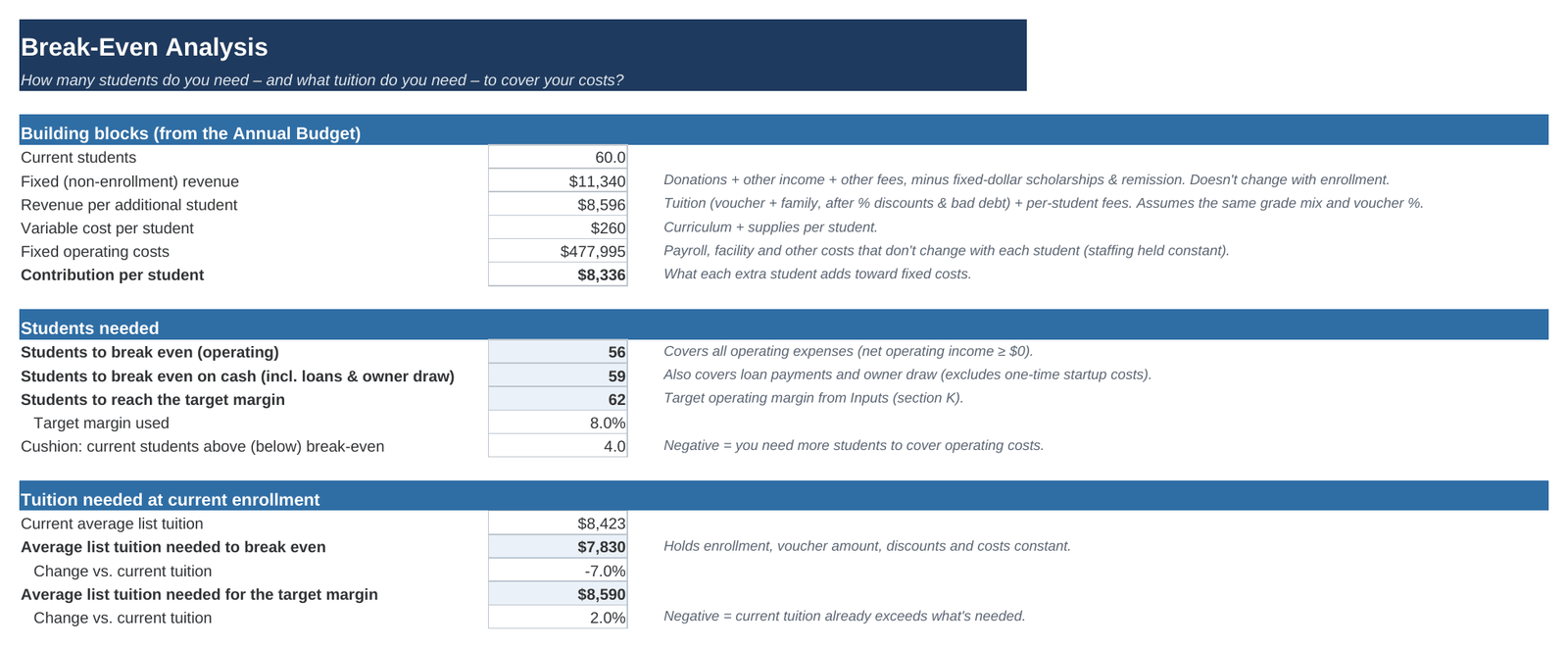
See how many students you need
Three break-even numbers: covering operating costs, covering cash (including loan payments and owner draw), and reaching your target margin. You'll also see the average tuition you'd need at your current enrollment.
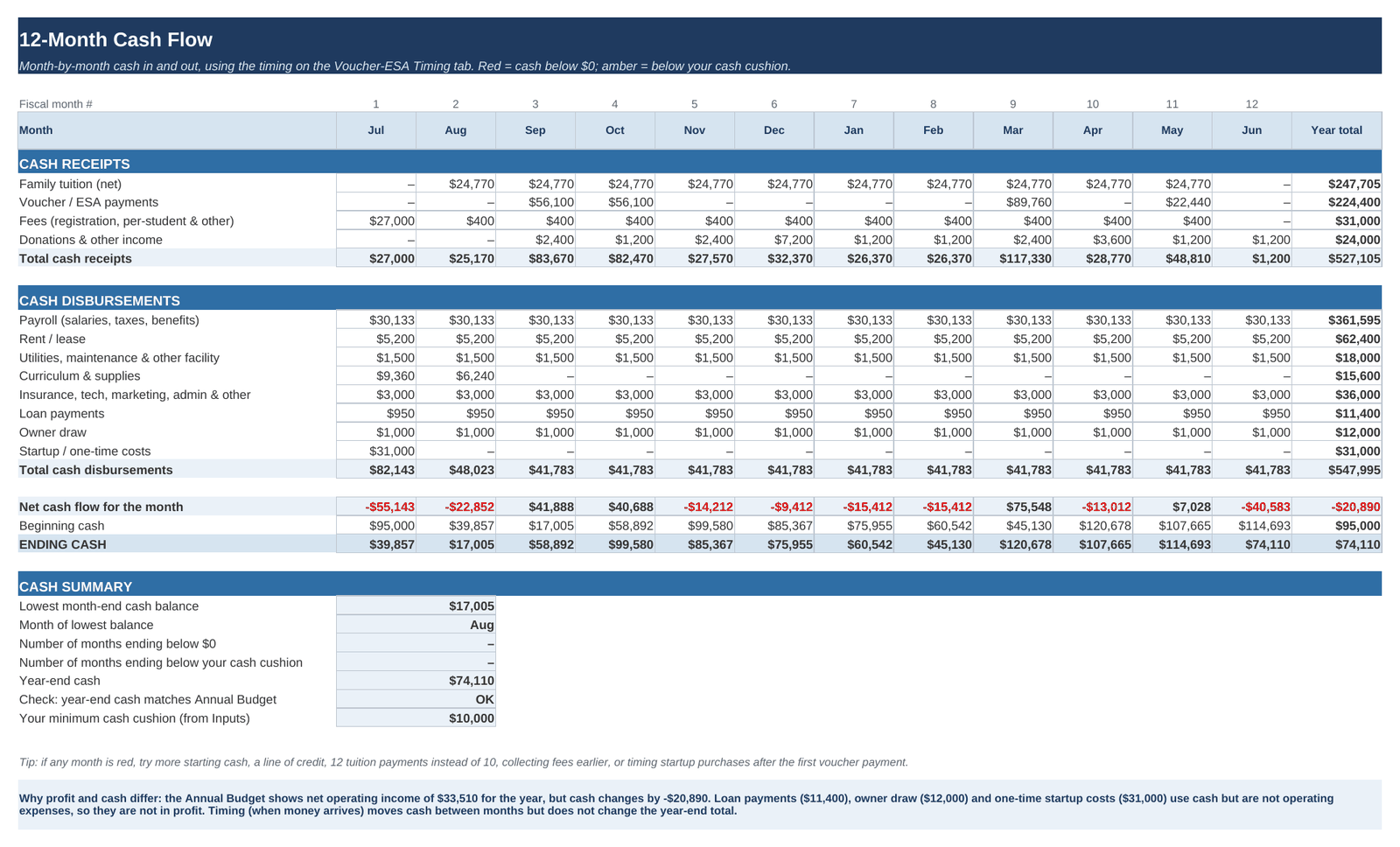
Find your cash low point before it finds you
A 12-month cash flow shows money in and money out for each month. Months below $0 turn red, and months under your safety cushion turn amber. The cash summary names your lowest month.
Model when voucher and ESA money arrives
Set the share of voucher money that arrives each calendar month, plus when you collect tuition and fees. Then watch your cash flow update. Use the payment schedule your state program confirms for your school.
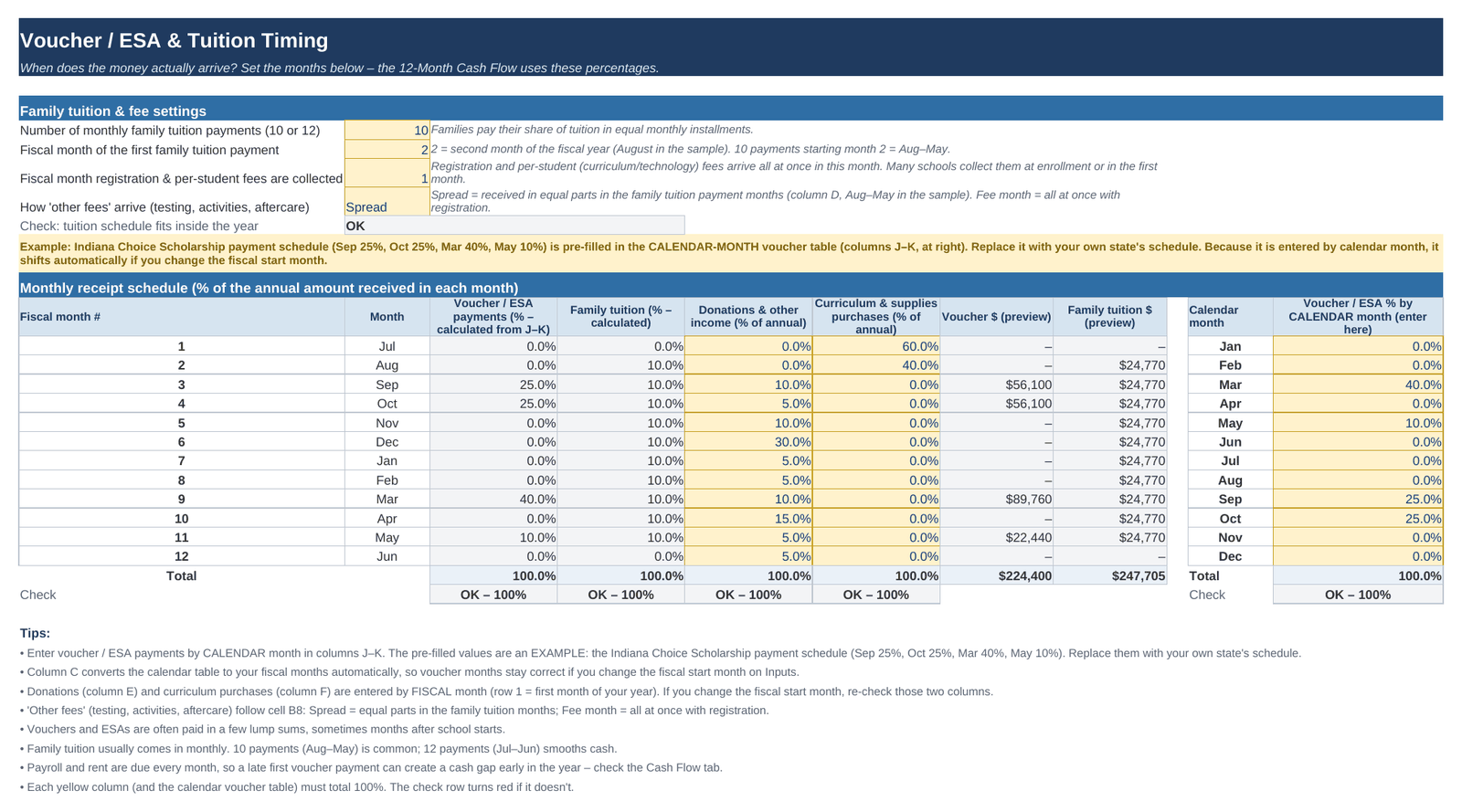
Comes with a 6-page PDF user guide. Works in Microsoft Excel and in Google Sheets (File › Save as Google Sheets).
Who it's for
Built for people who run small schools, not finance departments.
Founders planning a microschool
Test enrollment, tuition, and rent before you commit to a building or a hire.
Owners of small private and faith-based schools
Build next year's budget, set tuition, and see your summer cash gap ahead of time.
Hybrid programs and co-ops going formal
Turn a handshake budget into one you can show families, a landlord, or a lender.
Board members and treasurers
Get one clear picture of enrollment, cash, and break-even for board meetings.
Pricing
Pick the level of help you want.
One-time purchase for the Kit and Kit Plus. Instant download through Gumroad.
Founding launch pricing: Kit $39 (reg. $59), Kit Plus $89 (reg. $129) through Nov 8. Founder Coaching is $249/mo for the first 10 members, then $299.
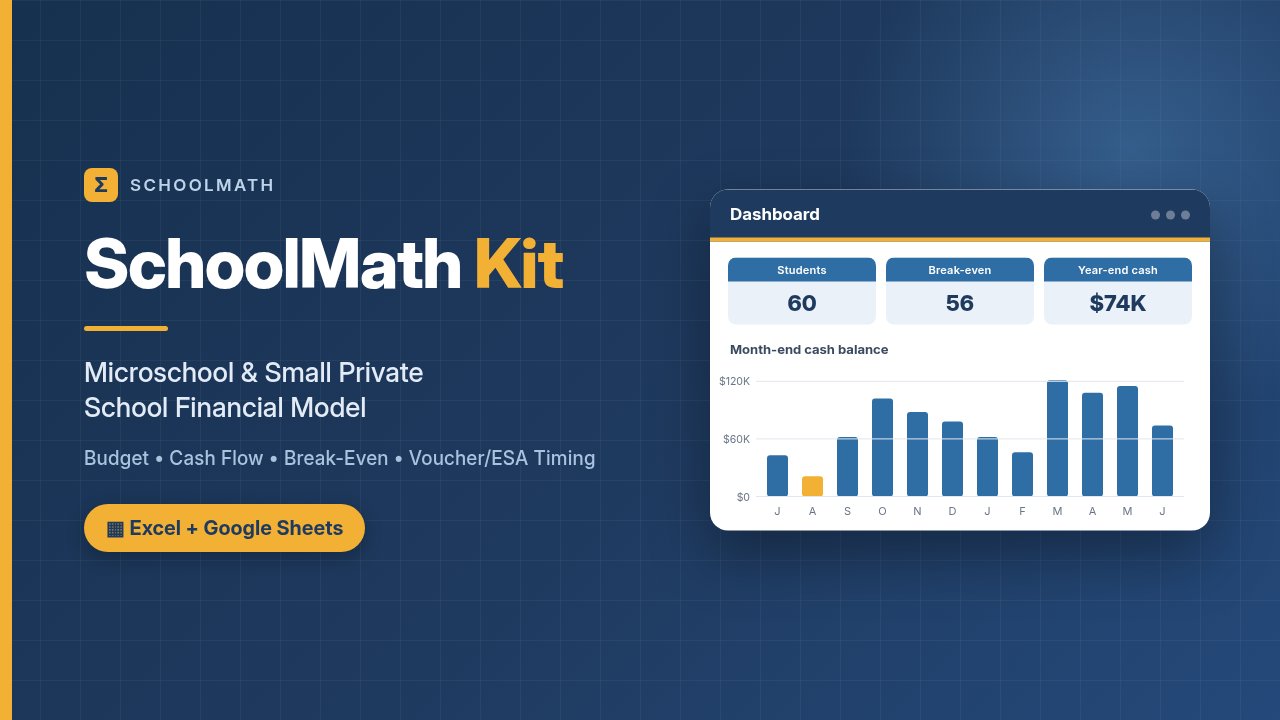
Kit
The financial model and guide.
- 8-tab Excel / Google Sheets financial model
- Budget, 12-month cash flow, break-even, scenarios, dashboard
- Voucher / ESA timing by month
- 6-page PDF user guide
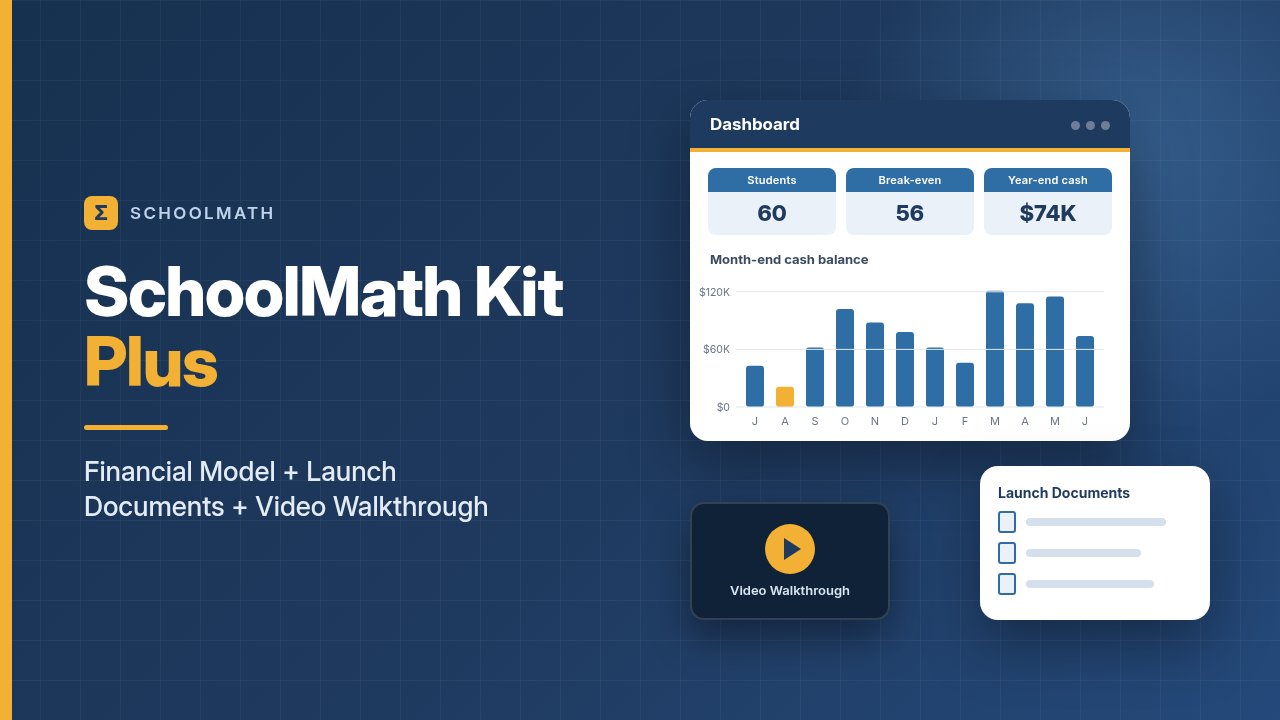
Kit Plus
Everything in the Kit, plus the documents that put it to work.
- Everything in the Kit
- Document kit: tuition policy, enrollment agreement template, board report, reserve policy, lender/landlord package, voucher/ESA checklist and more
- 40-question school finance Q&A library
- 25-minute video walkthrough of every tab, with two what-if demos: an enrollment drop and a rent increase
Founder Coaching
Everything in Kit Plus, plus a monthly call with me.
- Everything in Kit Plus
- One-hour video call each month to go over your numbers
- Book times that work for you online
- Limited to 10 founding spots
The templates are a starting point, not legal, tax, or financial advice. Have your attorney review agreements and policies before you use them.
Free download
The Microschool Break-Even Calculator
A one-tab spreadsheet. Enter students, tuition, vouchers, staff, and rent to see your monthly and annual net income, the enrollment you need to break even, the tuition you need to break even, and a table of enrollment vs. tuition.
- Free
- Excel & Google Sheets
- Instant download
FAQ
Questions founders ask
We show a profit for the year. Why are we short on cash in August?
Because money comes in on a different schedule than it goes out. Payroll and rent are due every month. Family tuition often starts in August, and voucher or ESA payments may not arrive until weeks after school starts. Startup and curriculum purchases usually land in July and August too. The Cash Flow tab shows your month-by-month picture and names your lowest month, so you can plan for it.
How much rent can my school afford?
The model uses a planning guideline: rent at or below about 15% of revenue is comfortable, 15–20% is a caution zone, and above 20% leaves little room for staff and reserves. It's a rule of thumb, not a rule. Also look at total facility cost. Utilities, cleaning, and repairs add up.
How do I know if my tuition is too low?
Start with your costs, not your competitors. Compare your operating cost per student with your net tuition per student, which is what you actually collect after discounts, aid, and bad debt. If tuition plus fees and donations per student doesn't cover cost per student with some margin, tuition is too low, whatever other schools charge.
How should I budget for voucher or ESA students?
Enter the share of students you expect to use a voucher or ESA and a conservative average award. Award amounts, eligibility, and payment schedules depend on program rules that change, so confirm current figures with your state program, such as the Indiana Department of Education for Indiana's Choice Scholarship. Don't rely on last year's numbers or another school's.
What does "break-even students" mean?
It's the enrollment at which your revenue covers your operating costs. The model splits costs into fixed costs (staff, facility) and per-student costs (curriculum, supplies). It also shows a cash break-even that covers loan payments and owner draw, and the enrollment you need to reach a target margin.
Do I need to be good at Excel? Does it work in Google Sheets?
No. You only type in the yellow cells, and every other cell is a formula with a note next to it in plain English. It works in Microsoft Excel, and in Google Sheets: upload the file to Google Drive and choose File › Save as Google Sheets. It doesn't use macros.
Is the sample data from a real school?
No. The model comes filled in with a fictional 60-student "Sample Academy" so you can see how everything works. Replace it with your own numbers.

About
Hi, I'm Jerry Ackerman.
I co-own and run a private school in Indiana. Every month I'm watching the same things you are: enrollment, payroll, rent, and when tuition and voucher money will actually show up.
I built SchoolMath Kit because most school finance spreadsheets are made for big districts or for accountants. This is the model I'd want on day one: plain English, one place to type your numbers, and answers you can act on.
Questions? Email me at jerry@schoolmathkit.com.